

Between September 23 and 25, 2026, The University of the West Indies, through the Office of the Board for Undergraduate Studies, staged its Inaugural Undergraduate Student Leadership Conference and Entrepreneurial Expo. The Conference was held under the theme, “Today’s Students, Tomorrow’s Leaders, towards 2050: Imagining Roles, Rights, Responsibilities, and Relationships” and drew participants from twelve countries and eleven higher education institutions.
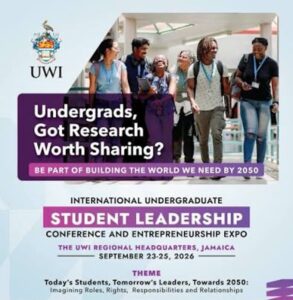
The conference was significant and instructive for several reasons, chief of which were that it:
- highlighted the important role of undergraduate students in contributing to research outputs of universities,
- expanded the scope of the discussion on the place of entrepreneurship as part of the university education.
Entrepreneurship and economic development
One of the characteristics of the entrepreneurial landscape in most developing societies, and indeed of the Caribbean, is that many young entrepreneurs undertake business activity, which in some cases involves building on their innovative ideas, based on necessity (faced with difficulty finding a job) rather than strategy, (driven by the vision and intellectual conviction to create a job). A related feature, somewhat consequential, is that most entrepreneurial undertakings fall in the Micro, Small, and Medium-sized enterprise (MSME) sector. Data from the Caribbean Development Bank indicate that in the Caribbean these account for 70% to 85% of businesses. These MSMEs contribute about 60% to 70%, and employ an average of 50% of the workforce, but up to 80% in Jamaica.

MSMEs contribute about 60% to 70%, and employ an average of 50% of the workforce, but up to 80% in Jamaica.
It is, therefore, no surprise that wages in the Caribbean are generally low, given that many workers are employed by MSMEs, many of which are struggling. This is not to suggest, however, that all large enterprises pay high wages. Given that MSMEs, many of which are struggling, contribute up to 70% of the region’s GDP, it is inevitable that the region’s GDP will be low compared to other regions.
Let us do a cursory comparison of the GDP of three randomly selected Caribbean countries compared to three non-Caribbean countries of similar populations, relative to the percentage of businesses in their MSME sector, innovation indices, and tertiary participation, plus two other large countries, both non-Caribbean with about the same percentage of their businesses being in the MSME sector. (See table below).
Selected Country Populations and MSME Sector-Size and Other Variables
| COUNTRY | POPULATION | % OF BUSINESSES IN MSME SECTOR | GDP(USD) | INNOVATION INDEX(out of 100) | TERTIARY PARTICIPATION | UNEMPLOYMENT RATE | GDP PER CAPITA |
| The Dominican Republic | 11.6M | 86% | $136B | 22.6 | 57.65% | 5% | $11,724.00 |
| United Arab Emirates | 11.5M | 63.5%(non-oil) | $571B | 44.2 | 63.7% | 2.17% | $49,652.00 |
| Jamaica | 2.8M | 97.6% | $23B | 25 | 29.4% | 3.7% | $8,214.00 |
| Lithuania | 2.8M | 74% | $105B | 40 | 61% | 6.2% | $37,500.00 |
| Bahamas | 405K | 98% | $15.8B | Not available | 15% | 9.2% | $39,012.00 |
| Iceland | 402K | 99% | $38.5B | 47 | 43.5% | 6.8% | $95,771.00 |
| Pakistan | 259M | 98.6 | $407B | 22 | 10% | 5.42% | $1,571.00 |
| Indonesia | 287M | 99.9 | $1.54T | 31 | 44% | 4.68% | $5,365.00 |
It is generally accepted that entrepreneurship drives economic growth through job creation and stimulating economic activity in communities. But as several case studies have shown, there can be economic growth without development. A 2026 study, authored by Easterly and colleagues which built on work done in 2001, showed that Pakistan while seeing growth in gross domestic product (GDP), continues to experience poor performance in human, social, and institutional indicators.
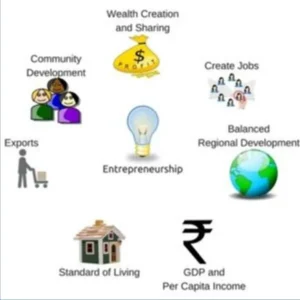
It is generally accepted that entrepreneurship drives economic growth through job creation and stimulating economic activity in communities. But as several case studies have shown, there can be economic growth without development. A 2026 study, authored by Easterly and colleagues which built on work done in 2001, showed that Pakistan while seeing growth in gross domestic product (GDP), continues to experience poor performance in human, social, and institutional indicators. Between 2001 and 2010, GDP growth in Pakistan averaged 4.47 % per annum. Between 2011 and 2019 it averaged 4.17% and with growth for 2026 projected at 3.7%, the average in the last three years will be 3.49%. Yet with that kind of growth, per capita income is among the lowest in the world; so too, in tertiary participation. Their innovation index is also relatively low. When compared to a country slightly bigger, Indonesia, but with about the same percentage of MSMEs, the GDP is almost four times greater, so is the tertiary participation and the per capita income.
Entrepreneurship and higher education
The data in the table tell several stories, and while it is to be readily acknowledged that there is no absolute “like-on-like” comparison among the countries, some insights can be inferred. I offer four such:
- The MSME sector accounts for a substantial share of business enterprises in most (if not all) countries.
- Despite the percentage of businesses in the economy being in the MSME sector, and their contribution to economic or GDP growth, such growth does not necessarily translate into improved quality of life for a country’s population.
- The rate of unemployment is not a primary indicator of the overall health of an economy, nor is there a correlation between low rates of employment and GDP per capita.
- There is generally a strong relationship between high levels of tertiary participation and a country’s innovation indices and per capita income.
The capacity of MSMEs to contribute to economic development, lies in the quality of research that informs innovation. Thus, a tripod for real social transformation consists of research, innovation, and entrepreneurship.
Based on the foregoing, and mindful of apparent outliers such as the Bahamas, and given the reliance of economies of MSMEs, the path to ensuring a greater impact of MSMEs on the economies of countries, a larger number of MSMEs must be driven / led by entrepreneurs who are innovating and creating higher value products and services. The key to accomplishing this is found in increased tertiary participation and the promotion of entrepreneurship among tertiary graduates. It is by so doing that a country will experience economic development, not just growth. The capacity of MSMEs to contribute to economic development, lies in the quality of research that informs innovation. Thus, a tripod for real social transformation consists of research, innovation, and entrepreneurship. The university has a key role to play in providing the context and capacity-building for research, the inspiration and infrastructure that drives innovation, and the cultural shift in expectations which encourages students to think about job creation as against getting a job that someone else has created. While the university must assume the responsibility for building this tripod, its sustenance and support will require partnerships with parents, students, industry leaders, and the State.
Canute Thompson is Professor of Educational Policy, Planning and Leadership, Pro Vice-Chancellor – Undergraduate Studies at The University of the West Indies, a social activist, and author of eight books and twenty journal articles.
His academic achievements include:
- Two Principal’s Awards in 2020 for Most Outstanding Researcher and Best Publication for his book, Reimagining Educational Leadership in the Caribbean.
- Two Principal’s Awards in 2023 for research activity generating the most funds, and research activity with the most development impacts, serving as Project Director for a project executed by the Caribbean Centre for Educational Planning.
- A 2022 Bronze place winner in the Independent Publisher Book Awards for his book, Education and Development: Policy Imperatives for Jamaica and the Caribbean.
- A 2021 finalist in The Vice-Chancellor’s Award for Excellence for all-round excellent performance in Outstanding Teaching, Outstanding Research Accomplishments, Outstanding Service to the University Community, Outstanding Public Service.
- A 2021 Principal’s Award for Most Outstanding Researcher.
The views expressed here are not necessarily those of The University of the West Indies.