
This article is a response to Don Robotham’s, “The bling theory of development” which appeared in The Gleaner on November 15, 2026.
Professor Don Robotham presents an interesting set of ideas in his column, “The bling theory of development”. Professor Robotham is a leading authority on development of small states. I agree with most of his article, but where we part company is on one recommendation, which is an issue close to my own work as Pro Vice-Chancellor for Undergraduate Studies.
Robotham sets out the 2024 graduation figures for natural sciences at Mona: 524 graduates, of whom 439 earned bachelor’s degrees, 71 earned taught master’s degrees and nine earned doctorates. His remedy is to cut undergraduate teaching loads drastically, turn some lecturers into full-time researchers, adopt the American “R1” research university as the goal, and graduate 71 doctorates a year instead of nine.

I share the ambition for more doctorates, but I read his numbers differently. Those 439 undergraduates are not what stand between The UWI and a research culture. They are the largest research resource we have, and the only pipeline from which those 71 future doctorates will come. If we free faculty for research by stepping back from undergraduate teaching and mentoring and building their research skills, we risk building a small research tier on top of a weaker foundation.
If we free faculty for research by stepping back from undergraduates, we risk building a small research tier on top of a weaker foundation.
You are invited to respond to the article and view other articles at leadershipreimagination.com.
Other of our own data point the same way. At Mona, research degrees make up only about 15 per cent of higher-degree enrolment, and the campus itself reports that more students choose taught programmes than research ones. The Vice-Chancellor’s report for 2024-2025 records that UWI-funded graduate scholarships went unfunded for a second year, with a direct effect on research enrolment. A plan that depends on multiplying funded doctorates nearly eightfold is a plan that has to wait for money. A plan that starts with the undergraduates is a plan ready to be executed and is being executed, not in competition but as a foundation and complement.
A plan that depends on multiplying funded doctorates nearly eightfold is a plan that has to wait for money. A plan that starts with the undergraduates is a plan ready to be executed and is being executed, not in competition but as a foundation and complement.
The international evidence on undergraduate research is unusually consistent. A ten-year study across several American universities, which matched participants with similar students who did not take part, found that those who did sustained, faculty-mentored research over two or more semesters were significantly more likely to finish a science degree, to be accepted into graduate training and to be working in science six years later. A national study of more than 4,000 American students found that undergraduate research raised the probability that they would plan for graduate study in science. Undergraduate research is not a distraction from doctoral education. It is how doctoral pipelines are built.
Undergraduate research is not a distraction from doctoral education. It is how doctoral pipelines are built.
The UWI’s Recent Practices
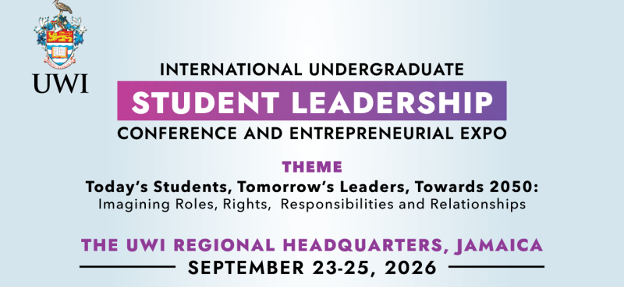
In September 2026 The UWI hosted its first International Undergraduate Student Leadership Conference and Entrepreneurship Expo at the Regional Headquarters in Jamaica, with students from eleven countries, and the papers they brought made the point better than I can.
A Bachelor of Agriculture student, asked why her country’s aquaculture industry had grown so slowly. She surveyed 119 people. Most were open to buying locally farmed fish, and 63 per cent said they would be more likely to buy if they had clear information on safety and sustainability. That is a labelling problem, and a ministry could act on it tomorrow.
In separate research, an undergraduate student and her lecturer interviewed sixteen employers and found that they value entrepreneurial skills but rarely advertise for them. At another Campus, an environmental science student, is designing a study of what students across our campuses know about sustainability. Yet another team of undergraduate students tested fermented pineapple peel against six bacteria and reported, honestly, that it worked on some and not on others. One paper on financing green entrepreneurs had ten authors from seven departments across four faculties and made recommendations for mobilising existing but underutilised government funds and strengthening academic tech-transfer.
None of this is doctoral research but much of it is decision-ready work that can inform production, teaching, policy, and practice.
The Graduate Pipeline
But the recent International Conference is not the only space in which The UWI is promoting and preparing undergraduate researchers and building the graduate and doctoral pipeline. At Barbados’ 2026 Research Frontiers Symposium, Cave Hill’s Department of Biological and Chemical Sciences presented work from undergraduates, Master of Philosophy students, alumni and lecturers’ side by side. At the Five Islands Campus, our youngest campus birthed in 2019, undergraduate students are undertaking research anchored by a Centre of Excellence for Oceanography and the Blue Economy. A campus that young cannot wait for a doctoral tier to form before it does research. The Global Campus has made raising student research engagement part of its mission. The foundation exists in every corner of the university. We need to be build upon this deliberately.
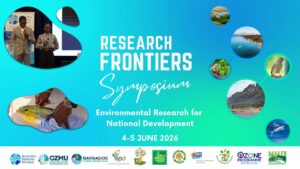
At the Five Islands Campus, our youngest campus birthed in 2019, undergraduate students are undertaking research anchored by a Centre of Excellence for Oceanography and the Blue Economy. A campus that young cannot wait for a doctoral tier to form before it does research.
America’s leading research universities did not get there by separating research from undergraduate teaching. They fused them. The Massachusetts Institute of Technology (MIT) has run its Undergraduate Research Opportunities Programme since 1969, and across the American research universities, undergraduates are part of the workforce in the laboratories. Being an R1 university is the result of a deep research culture, and that culture begins in the first degree.
Professor Robotham ends by saying there is no shortcut and that the work should start now. I agree, and I can report that at The UWI it already has.
Canute Thompson is Professor of Educational Policy, Planning and Leadership, Pro Vice-Chancellor – Undergraduate Studies at The University of the West Indies, a social activist, and author of eight books and over twenty peer-reviewed journal articles. He has won over a dozen academic and leadership awards.
His academic achievements include:
- 2025: Finalist in the 2025 Goody Business Book Awards, “Leadership – Think Differently” Category for the book, Reimaginative Leadership: Concepts and Applications.
- 2024: Principal’s Award – Most outstanding researcher activity for the Academic Year 2022/23 (shared with a colleague)
- 2023: Principal’s Award – Made to the Caribbean Centre for Educational Planning (CCEP) for Research Activity generating the most funds. Role: Project Director.
- 2023: Principal’s Award- Made to the Caribbean Centre for Educational Planning (CCEP) for Research Activity with the most development impacts. Role: Project Director.
- 2022: Bronze place winner in the 2022 Independent Publisher Book Awards for the book, Education and Development: Policy Imperatives for Jamaica and the Caribbean, published by the UWI Press in 2020
- 2021: Finalist in The Vice-Chancellor’s Award for Excellence for all-round excellent performance in Outstanding Teaching, Outstanding Research Accomplishments, Outstanding Service to the University Community, Outstanding Public Service.
- 2021: Principal’s Award – Most Outstanding Researcher
The views expressed here are not necessarily those of The University of the West Indies.