
I have been exploring the issue of the challenges and opportunities in the global higher education landscape and what they can mean for publicly-funded tertiary institutions in the Caribbean.
In last week’s article, I highlighted the fact that the crisis facing British higher education institutions did not happen “overnight”, but began two decades ago. Thus, I concluded that part of what is being seen in the UK higher education sector is a failure to have acted before the crisis hit. The publicly-owned tertiary sector in the Caribbean, has the opportunity, within the context of a collaborative approach to shaping the future, of taking steps today, to stave off the prospect what the UK higher education sector is experiencing. The UWI has been seeking to build this inter-institutional collaborative model evidenced in various franchise arrangements it has with Community Colleges across the region as well as agreements for Teachers’ Colleges to offer UWI degrees. These approaches need to be deepened as stakeholders collectively examine how to strengthen and protect higher education in the Region.
The publicly-owned tertiary sector in the Caribbean, has the opportunity, within the context of a collaborative approach to shaping the future, of taking steps today, to stave off the prospect what the UK higher education sector is experiencing.
You are invited to respond to the article and view other articles at leadershipreimagination.com.
In addition to the strategy of collaboration, there are three other critical strategies for preventing the UK-type higher education crisis. The first is that Caribbean higher education institutions must offer products that are supportive of the developmental needs of the region. The second is that students (of all ages and stages) must be able to access these products, and the third is a sustainable funding model that makes these institutions viable.
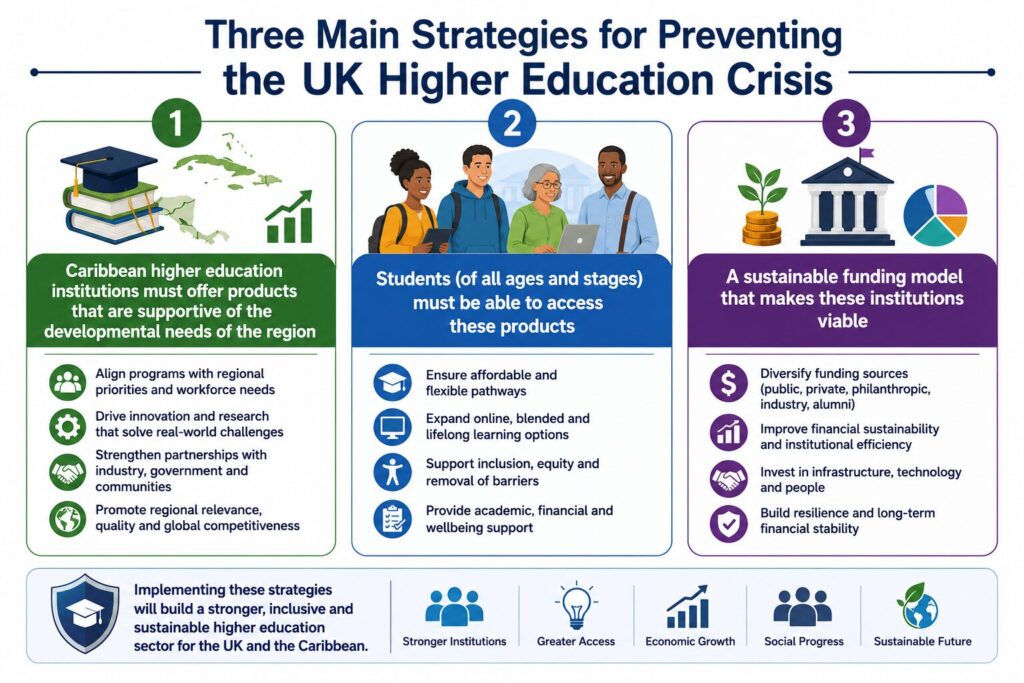
Today I discuss one such sustainable funding model, the Quad P Partnership Model.
One of the painful realities of the developmental experience of the Caribbean is that less than one-third of our citizens (members of the workforce) have post-secondary qualifications. While there has been extensive discussion on this fact there has been very, very slow movement towards transformation, such that the Caribbean region is afflicted by the triple curse of low skills, low wages, and low levels of technological solutions. Addressing this triple curse remains an enduring imperative. The Quad P Partnership Model does that.
One of the painful realities of the developmental experience of the Caribbean is that less than one-third of our citizens (members of the workforce) have post-secondary qualifications.
The Quad P Partnership Model
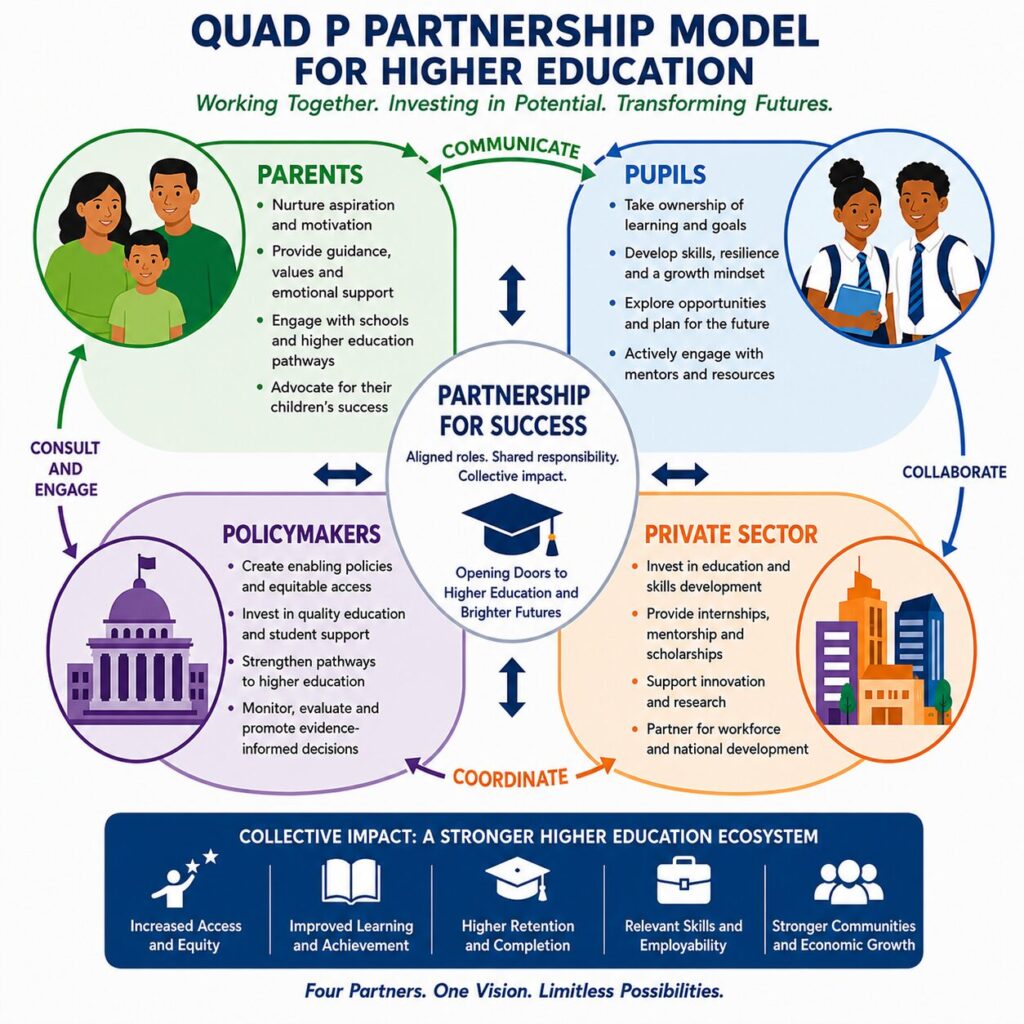
This model conceives of higher education as a partnership among four players in society. The necessity of this partnership arises from the asymmetrical features in former colonial societies where there are characteristics such as maldistribution in wealth and opportunity, disparities and inequities in the educational levels of the population, historical disadvantages related to social class, skin colour, place of origin or residence, and ultimately lagged and slow progress towards sustainable development. These conditions necessitate that greater collaboration in overcoming these challenges is needed.
This Quad P model, which I first discussed in 2020 in the book Education and Development: Policy Priorities for Jamaica and the Caribbean, has as its starting point the assertion of the view that higher education (in developing economies) cannot be the sole business of the family or the government. This Quad P model has as its starting point a rejection of the notion that higher education (in developing economies) can be the sole business of the family or the government. And while the private return on investment in higher education mainly benefits the individual, the state also benefits. Thus, Quad P, locates four parties or players in the policy mix: parents, pupils, policymakers, and the private sector.
How Quad P works
The aim of Quad P is to increase access to tertiary education by increasing the amount of money available to people who wish to pursue higher education, WITHOUT increasing the burden on any of the parties – parents, pupils, policymakers, or private-sector players. The key to doing this is based on the strategy of “a little bit at a time, over a long time”.
The aim of Quad P is to increase access to tertiary education by increasing the amount of money available to people who wish to pursue higher education, WITHOUT increasing the burden on any of the parties – parents, pupils, policymakers, or private-sector players. The key to doing this is based on the strategy of “a little bit at a time, over a long time”.
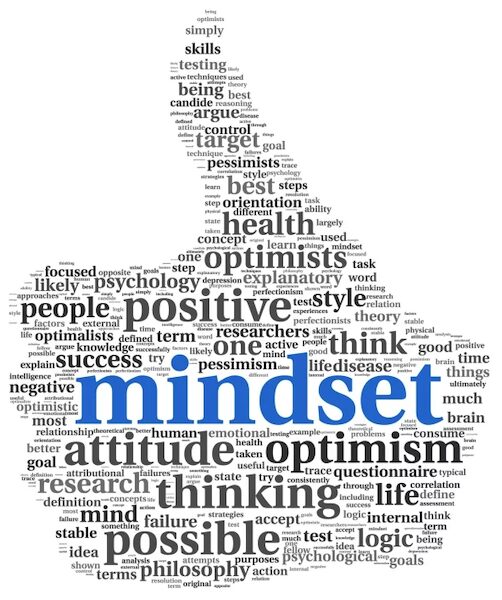
The math is simple. The formula is a combination of mindset and money.
At the mindset level, the formula is this:
- Each parent commits to making tertiary education a priority.
- Each child aspires to taking advantage of tertiary education as part of his or her development agenda.
- Governments affirm their role in the provision of access to (not just primary and secondary but also) quality tertiary education.
- The private sector (particularly financial institutions) recognizes their social responsibility to provide targeted support to make education for all a reality while still making a profit.
In monetary terms, the structure of the policy is this:
- Each parent, in addition to any other plans they will have for their child’s / children’s education, plans to save the equivalent of USD $1.00 per day towards tertiary education, before the child is born or as soon as the child is born. In Jamaica that is about JMD $150.00, in Barbados that is BD $2.00, in Antigua that is $2.70, and in Trinidad and Tobago that is TT $6.70. This USD $1.00 per day is $30.00 per month and $360.00 per year.
- The government seeds an account with the equivalent of USD $100.00 in the name and on behalf of each child, the year following the child’s birth. So, all children born in 2026 will have their accounts seeded in 2027.

Government’s Investment
The government’s investment in the Quad P Partnership Proposal would be by way of a one-off seed funding. Using the three-year average of births across four countries, the investment profile is shown in Table 1.
Government’s Investment Profile of Four Selected Countries in the “Quad P Partnership” Proposal
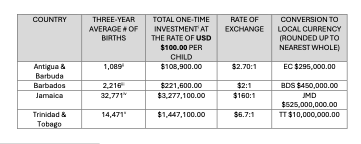
| COUNTRY | THREE-YEAR AVERAGE # OF BIRTHS | TOTAL ONE-TIME INVESTMENT[i] AT THE RATE OF USD $100.00 PER CHILD | RATE OF EXCHANGE | CONVERSION TO LOCAL CURRENCY (ROUNDED UP TO NEAREST WHOLE) |
| Antigua & Barbuda | 1,089[ii] | $108,900.00 | $2.70:1 | EC $295,000.00 |
| Barbados | 2,216[iii] | $221,600.00 | $2:1 | BDS $450,000.00 |
| Jamaica | 32,771[iv] | $3,277,100.00 | $160:1 | JMD $525,000,000.00 |
| Trinidad & Tobago | 14,471[v] | $1,447,100.00 | $6.7:1 | TT $10,000,000.00 |
These investments would have a life of eighteen years, on the assumption that a child would be ready for post-secondary education (community college, teachers’ college, advanced skills training institutes, university) at age 18.
Parents’ and Pupils’ Investments
Parents and pupils would make their investments of the equivalent of USD $1.00 per day. Between birth and age six, parents would pay the child’s portion. Between ages six and eighteen, students would be expected to make their investments from funds provided to them by parents and relatives, and earnings they make through holiday employment. By combining the government’s investment with the parents’ and pupils’ $1.00 per day, the yield from the investment would be what is shown in Table 2.
Table 2
Yield from Investments over 18 years
| COUNTRY | GOVERNMENT SEEDED AMOUNT(see Table 1) | TOTAL PARENTAL AND PUPIL CONTRIBUTION AT USD $1.00 PER DAY (based on baseline number of children in Table 1) | INT RATE[vi] | YIELD AFTER 18 YEARS(rounded) | AMT PER CHILD IN YR 18 IN LOCAL CURRENCY | USDEQUIV(rounded) |
| Antigua & Barbuda | EC $295,000.00 | $1,073,210.00 | 4% | $28.1M | $26K | $9.5K |
| Barbados | BDS $450,000.00 | $1,617,680.00 | 6% | $52.3 | $23.6K | $11.8K |
| Jamaica | JMD $525,000,000.00 | $1,913,826,400.00 | 6% | $60.6B | $1.8M | $11.6K |
| Trinidad & Tobago | TT $10,000,000.00 | $36,049,115.00 | 4% | $945M | $63.3K | $9.7K |
The Impact
A Bachelor of Science degree at the Cave Hill Campus in Barbados, currently costs about BDS $6,300.00 per year. Assuming a 40% change in price over 18 years, the cost will be about $8,800.00. With a package of $23.6M, a student would have available a substantial sum to help to pay for his or her education. The same analysis can be done for the other countries.
The Contribution of the Private Sector
The contribution of the private sector, mainly the financial institutions and media houses, will be, in the first place, for the financial institutions to guarantee a reasonable rate of return as shown above, and to invest the funds wisely. Further the financial institutions would also exempt these funds from some of the normal handling and management fees and the returns to the account holders (the students) would not be taxed by the state. Secondly, the media would be in the vanguard promoting the policy and getting all partners to buy into it.
Messaging: “Think Tertiary Early” – The New Zealand Model
This model of promoting tertiary education has been successfully used by New Zealand. In the 1980s New Zealand had an elite tertiary education system. Operating in a highly rural and agrarian economy, most families thought that tertiary education was not necessary and for those who desired it, many thought it was the duty of the state to finance it. But starting in the second half of the 1980s, the government articulated a vision of a more educated population and started the public education campaign called “Think Tertiary Early”. The policy, supported by measures such as the one discussed here, was highly successful and today, New Zealand has a mass tertiary education system with a participation rate of 90%.
The Caribbean needs such a system.
[i] Each cohort of children would have a one-off state investment for the purposes of this proposed policy.
[ii] Covers the period 2018 – 2020; the latest available
[iii] Covers the period 2021 – 2023
[iv] 2022 – 2024
[v] 2022 – 2024
[vi] Rates used are based on data on interest rates on high-yield investment instruments in each country.
Canute Thompson is Professor of Educational Policy, Planning and Leadership, Pro Vice-Chancellor – Undergraduate Studies at The University of the West Indies, a social activist, and author of eight books and over twenty peer-reviewed journal articles. He has won over a dozen academic and leadership awards.
His academic achievements include:
- 2025: Finalist in the 2025 Goody Business Book Awards, “Leadership – Think Differently” Category for the book, Reimaginative Leadership: Concepts and Applications.
- 2024: Principal’s Award – Most outstanding researcher activity for the Academic Year 2022/23 (shared with a colleague)
- 2023: Principal’s Award – Made to the Caribbean Centre for Educational Planning (CCEP) for Research Activity generating the most funds. Role: Project Director.
- 2023: Principal’s Award- Made to the Caribbean Centre for Educational Planning (CCEP) for Research Activity with the most development impacts. Role: Project Director.
- 2022: Bronze place winner in the 2022 Independent Publisher Book Awards for the book, Education and Development: Policy Imperatives for Jamaica and the Caribbean, published by the UWI Press in 2020
- 2021: Finalist in The Vice-Chancellor’s Award for Excellence for all-round excellent performance in Outstanding Teaching, Outstanding Research Accomplishments, Outstanding Service to the University Community, Outstanding Public Service.
- 2021: Principal’s Award – Most Outstanding Researcher
The views expressed here are not necessarily those of The University of the West Indies.