

One of the most sacred doctrines (in my view) in public administrative law is the doctrine of reasonableness. (The doctrine is also applicable to criminal law, but my exposure is to administrative law). This doctrine holds that in the exercise of power, decision makers cannot be arbitrary, capricious, high-handed, or irrational, and that in arriving at any decision they must offer sound legal and logical bases for doing so.

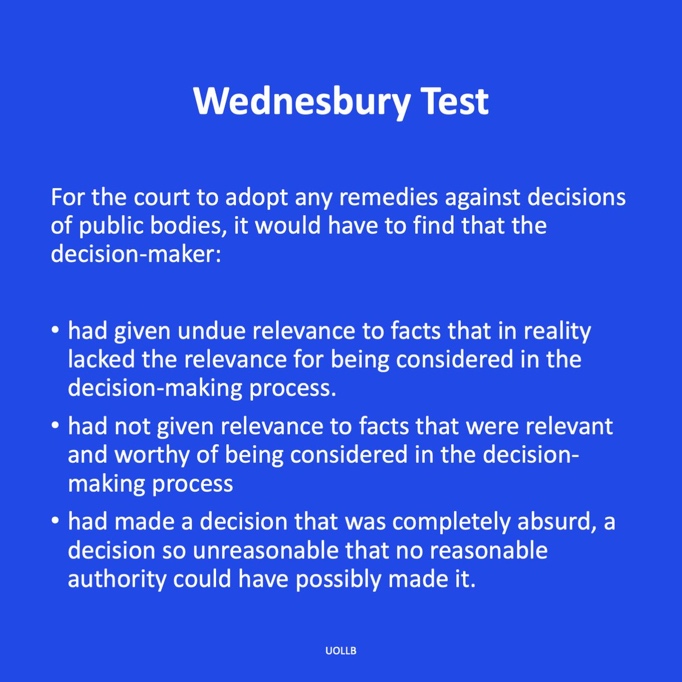
Unreasonableness is one of the three primary grounds on which an aggrieved person may seek judicial review of a decision made by a public authority . The other two are illegality and impropriety. The doctrine of reasonableness originated in what is known in English Law as Wednesbury test, and is expressed simply as a question of whether a decision is rational, and whether any reasonable person faced with the same set of facts would make such a decision.
The doctrine of reasonableness originated in what is known in English Law as Wednesbury test, and is expressed simply as a question of whether a decision is rational, and whether any reasonable person faced with the same set of facts would make such a decision.
In a little-known 2008 case in which I was involved, in a small Commonwealth country, a senior officer who resigned from his post, citing interference and meddling by the Permanent Secretary, was later fired. He regarded the decision to dismiss him not only as an attempt to tarnish his reputation, but as an act of unreasonableness. He took the matter to the Supreme Court, seeking judicial review, and won. The Court held that the decision to “dismiss” after the resignation letter was submitted was simply irrational and unreasonable and unfair. One key element of the Court’s ruling surrounded Lord Diplock’s dictum, that public officials have a duty to be fair.
There have been other well-known cases across the Commonwealth including a Barbadian case Leacock Johnson v AG, and a Jamaican case of Jennings vs NCB. In both cases, unreasonableness was at the heart of the rulings, one of which reached the Privy Council. I discuss the matter of reasonableness in a 2017 article in the Jamaica Observer. The article is titled “Lessons in Reasonableness” and is available at https://www.jamaicaobserver.com/2017/08/12/lessons-in-reasonableness/
The Bengal Ruling
The Bengal Development Limited case has opened up instructive new avenues for redress in instances in which an aggrieved party contends that a decision-maker has exercised power unreasonably. In brief, the case involves an application for a mining permit. The company Bengal had sought a permit to mine bauxite and limestone in an ecologically-sensitive area called the Dry Harbour Mountains in St. Ann. The entity responsible for granting the permit, the Natural Resources Conservation Authority (NRCA), denied the application. Using the provisions of the law which give the portfolio minister the authority to overturn decisions of the agency, the company appealed to the minister (who is also the Prime Minister). The minister overturned the decision of the NRCA and granted the permit but, instructively, gave no reasons.

A group of citizens challenged the decision of the minister, and the matter was heard by the Constitutional Court, which overturned the decision of the minister and ruled that the decision was “unconstitutional, void, and of no effect”. The Court also made the declaration that the permit was likely to breach residents’ rights to a healthy environment and the protection of their ecological heritage.
Lessons
I was always uncomfortable with the prospect of mining in the Dry Harbour Mountains, as my tweets / posts at the time of the controversy would disclose. For this reason, I welcome the ruling. But there are four other reasons for which I welcome this ruling, each of which is at the heart of the principle of reasonableness and extends outwards to the broader question of good governance.
These are they:
- Mandatory Requirement for Reasons to be given
The Court held that while the minister has the authority to overturn a decision of the NRCA it cannot lawfully do so without giving reasons for its decision. This argument by the court places the requirement for rational decision-making at the centre of the exercise of authority. In simple terms, decisions have to be shown to be grounded in something. In theory, a decision-maker can hide behind the absence of a reason and through this means evade a challenge.
There was, for example, in employment contract law in Jamaica, a provision which stated that either party may terminate the contract “at any time without having or giving a reason”. That provision was abused by many employers, including the government. This provision was introduced in the public sector in Jamaica in the 1990s. Many contract (vs permanent) employees were subject to being called to a meeting and told that their contracts were terminated and no reason given. The employee, therefore, (or so it was thought) had no basis to mount a challenge as no reason was given. This provision has been found by the Privy Council to be unconstitutional, and therefore is applicable to employees in the private sector.

The lesson here is that a decision-maker, despite having discretion to make certain decisions, must, certainly in the case of decisions made by public bodies, furnish reasons for those decisions.
The lesson here is that a decision-maker, despite having discretion to make certain decisions, must, certainly in the case of decisions made by public bodies, furnish reasons for those decisions.
- Necessity for Superiority of the Reasons
One key element of this affirmed constitutional requirement for providing reasons for decisions, is that the reasons behind those decisions must be superior to the reasons behind the decision purported to being overturned. This insight was articulated by attorney for the appellants, KC Michael Hylton, as reported by the Gleaner on May 7, 2026. Hylton’s explanation suggests that for the Court to find that the substitution of a decision by a higher authority to be deemed lawful and constitutional, such substituted decision must expose defects in the original decision and thus posit new grounds which are logically, legally, constitutionally, and pragmatically superior to the original grounds.

- Limiting the Prospects of Absurdity
The unlimited exercise of power whether in private organizations or the public sector is dangerous.Where the requirement to provide reasons for decisions taken does not exist the situation becomes even more dangerous as it creates the space for absurd, capricious, and even self-serving, but masked, intents. This new bar set by the Constitutional Court effectively destroys all those prospects, and thus, restores accountability and transparency to the infrastructure of governance.
The unlimited exercise of power whether in private organizations or the public sector is dangerous.
- Preservation of the Role of Technical Experts
The provision in the NRCA Act which gives the minister the power to overturn a decision of the agency is troubling for several reasons, including (as outlined above that a minister can do so without giving reasons) but also for the fact it makes a mockery of technical experts. In practice, a minister, with no technical knowledge or expertise in an area, and with probably no exposure to the field, can unilaterally, or with the input from less competent people, overrule a body of experts. That is absurdity.
The judgement of the Constitutional Court is, therefore, a win-win.
The judgement of the Constitutional Court is, therefore, a win-win. On the one hand, it preserves the power of the minister to act as a “court of appeal” (as may be needed in circumstances in which an agency may, itself, abuse its discretion). On the other hand, the judgement shields public policy from capriciousness and irrationality by requiring a minister to give valid and superior reasons for any decision to substitute the ruling of an agency. Happily, so.
Canute Thompson is Professor of Educational Policy, Planning and Leadership, Pro Vice-Chancellor – Undergraduate Studies and Director of the Caribbean Centre for Educational Planning at The University of the West Indies, Mona Campus, a social activist, and author of eight books and twenty journal articles.
His academic achievements include:
- Two Principal’s Awards in 2020 for Most Outstanding Researcher and Best Publication for his book, Reimagining Educational Leadership in the Caribbean.
- Two Principal’s Awards in 2023 for research activity generating the most funds, and research activity with the most development impacts, serving as Project Director for a project executed by the Caribbean Centre for Educational Planning.
- A 2022 Bronze place winner in the Independent Publisher Book Awards for his book, Education and Development: Policy Imperatives for Jamaica and the Caribbean.
- A 2021 finalist in The Vice-Chancellor’s Award for Excellence for all-round excellent performance in Outstanding Teaching, Outstanding Research Accomplishments, Outstanding Service to the University Community, Outstanding Public Service.
- A 2021 Principal’s Award for Most Outstanding Researcher.